Next-Generation Firewall (NGFW): Complete Guide
Description
Learn what a next-generation firewall (NGFW) is, how it works, its key features, benefits, limitations, and deployment considerations.
Scope
This guide is for IT teams, network security professionals, administrators, and readers who are new to next-generation firewalls (NGFWs).
It explains:
- What an NGFW is
- Why NGFWs became necessary
- How NGFWs work
- Limitations of traditional firewalls
- Core and modern NGFW features
- Benefits of NGFWs
- Common NGFW misconceptions
- NGFW vs. traditional firewalls
- What to look for when choosing an NGFW
- How to deploy an NGFW in 11 steps
- NGFW comparisons with WAF, UTM, FWaaS, and network firewalls
- Frequently asked questions about NGFWs
The guide is based on the supplied technical source and keeps its original technical scope and image sequence.
1. What Is a Next-Generation Firewall (NGFW)?
A next-generation firewall (NGFW) is a network security device that identifies and controls applications, users, and content so organizations can enforce precise security policies.
Unlike traditional firewalls that primarily evaluate ports and protocols, NGFWs inspect traffic more deeply. They can identify applications, users, and content while also providing intrusion prevention and threat detection capabilities.
This deeper inspection helps detect threats and prevent the misuse of legitimate applications while providing consistent, inline protection.
2. What Created the Need for NGFWs?
Next-Generation Firewall (NGFW) emerged because traditional perimeter security was no longer enough.
Modern network security needed more context and control, especially as traffic became more complex, encrypted, and evasive.
Why Traditional Firewalls Became Less Effective
In the late 2000s, applications began behaving differently. Many applications used the same ports or tunneled through SSL. This made it harder for traditional firewalls to identify whether traffic was legitimate or determine which application was actually running, highlighting the need for Next-Generation Firewall technology.
Threats also became more evasive. Malware could hide inside encrypted traffic, while attacks increasingly targeted specific applications, users, and data.
Traditional security tools lacked:
- Application awareness
- Encrypted-content inspection
- Meaningful user identification
These limitations created the need for NGFW technology.
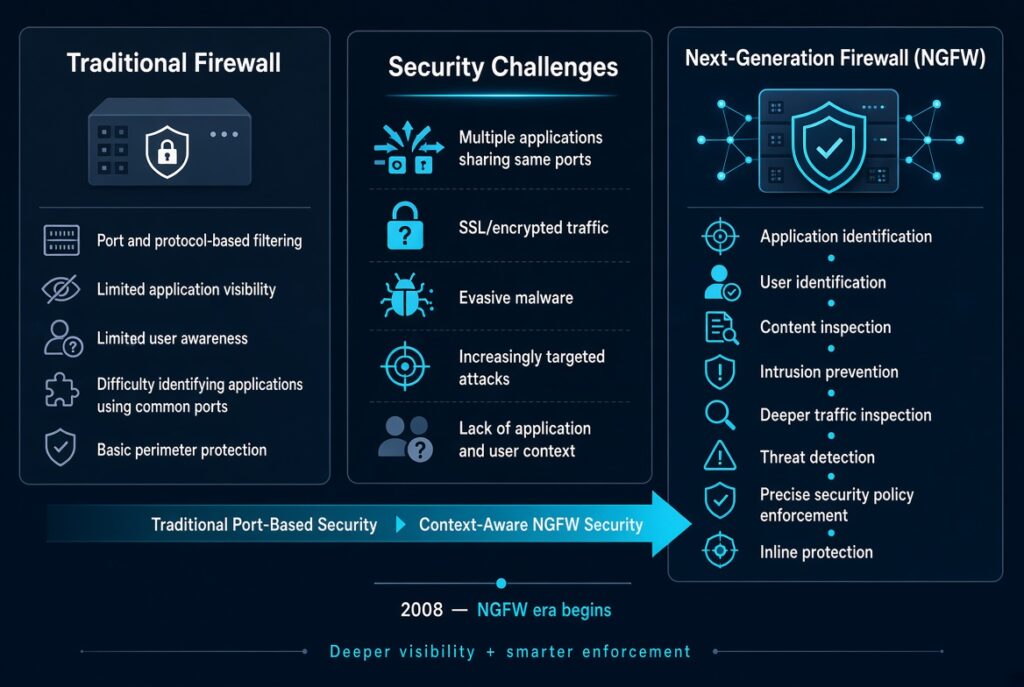
In 2008, Palo Alto Networks delivered what the source describes as the industry’s first next-generation firewall. The NGFW was designed to provide deeper visibility and smarter enforcement.
It combined traditional firewall capabilities with integrated intrusion prevention and full-layer inspection. Instead of recognizing traffic only by port, it recognized applications and helped enforce policies based on who was using them.
3. How Does an NGFW Work?
A Next-Generation Firewall (NGFW) analyzes network traffic beyond basic IP addresses and ports. It inspects traffic to understand the application, user, and content involved in a transaction.
In simple terms, a Next-Generation Firewall (NGFW) does not only ask where traffic came from. It also looks at what the traffic is doing and who is responsible for it.
A Next-Generation Firewall (NGFW) operates at higher layers of the OSI model, including the application layer. Many threats can exist inside common services such as email, file sharing, and web traffic.
By inspecting traffic at Layer 7, a Next-Generation Firewall (NGFW) can recognize applications and detect evasive behavior. This allows security policies to be based on how applications are actually being used rather than only where the traffic appears to be going.
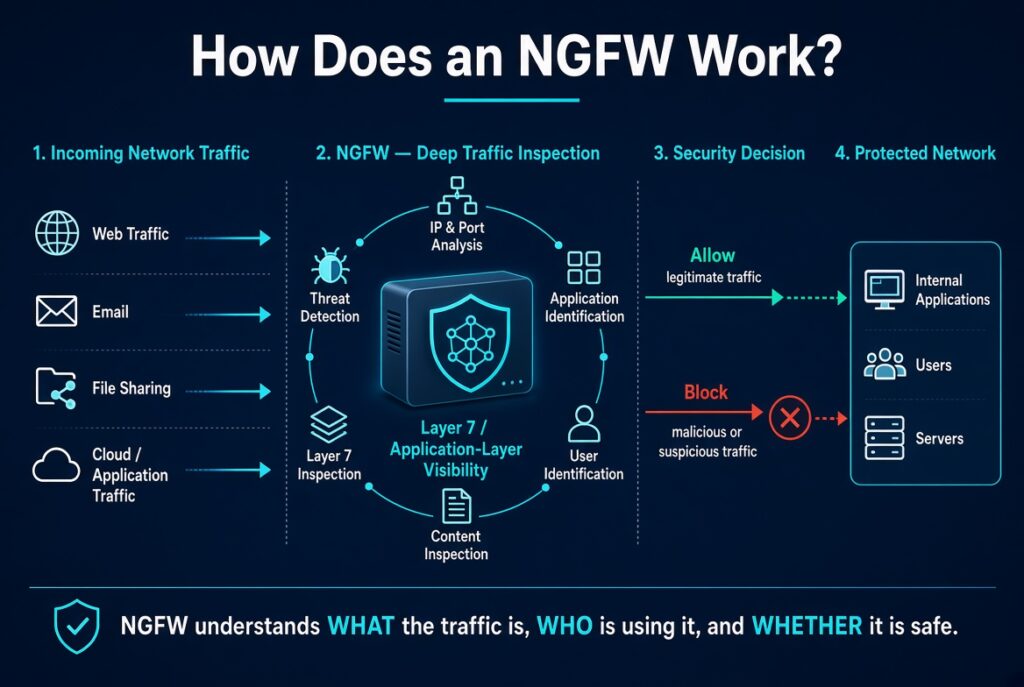
The deeper inspection provided by NGFWs also supports advanced threat prevention. Malicious traffic can be blocked in real time, including traffic that attempts to appear normal.
4. What Are the Limitations of Traditional Firewalls?
Traditional firewalls were designed for environments where applications were predictable, threats moved more slowly, and networks had clearer perimeters.
Modern applications, users, and threats have changed that environment.
Modern applications, users, and threats have changed that environment.
The main limitations include:
- Poor application visibility
- Inadequate threat detection
- Binary access controls
- Dependency on add-ons
- Operational complexity
Poor Application Visibility
Traditional firewalls classify traffic using ports and protocols. This worked when applications followed fixed port assignments.
Modern applications may use:
- Nonstandard ports
- Port hopping
- Tunneling
- Encryption
As a result, legacy firewalls can have difficulty detecting and controlling applications.
For example, a messaging application may use port 443 just like ordinary web traffic. A Next-Generation Firewall can distinguish between these applications, whereas a port-based firewall can see both as the same type of traffic.
This creates a lack of visibility for IT teams and makes meaningful application-level control difficult.
Inadequate Threat Detection
Older firewalls focus on blocking known threats at the network layer. Modern attacks, however, often operate at the application layer and change quickly.
Traditional firewalls may not inspect enough traffic to detect these threats. A Next-Generation Firewall can address this challenge through deeper traffic inspection. Encrypted traffic creates an additional challenge because threats can remain hidden inside SSL or TLS sessions when the firewall cannot decrypt and inspect them.
Traditional firewalls therefore may not be designed to analyze complete sessions.
Binary Access Controls
Legacy firewalls are generally limited to allow-or-block decisions.
They cannot always distinguish between safe and risky uses of the same application.
For example, a cloud storage application may be useful for collaboration but could also create a data-exfiltration risk.
The same application could be used to share internal files with coworkers or send sensitive data outside the organization.
Without user, content, and function-level awareness, traditional firewalls lack the context required for more precise policies, while a Next-Generation Firewall provides these additional capabilities.
Dependency on Add-Ons
Organizations may add separate security tools such as intrusion prevention systems, URL filters, or antivirus appliances to extend traditional firewall capabilities.
However, connecting multiple tools can create complexity. Policies become distributed across different consoles, and poor integration can create security gaps.
For example, a port-based firewall might allow traffic on port 443 while an external IPS attempts to inspect that traffic. If the application is not correctly classified or the IPS does not see all traffic, something may pass through.
Managing policies across separate tools is difficult to scale and can create visibility gaps.
Operational Complexity
Adding more security devices does not always improve security.
Multiple devices can introduce:
- Configuration errors
- Policy conflicts
- Response delays
- Additional management overhead
Legacy firewalls were not designed around the deep inspection, identity-based policies, and application-level controls required by modern hybrid environments.
More tools also mean more rules, more consoles, and more opportunities for something to fail.
5. What Are the Features of an NGFW?
NGFW capabilities can be divided into core features and modern features.
Core NGFW Features
- Application identification
- User identification
- Content inspection
- Granular policy enforcement
- SSL decryption
- Single-pass architecture
Modern NGFW Features
- Advanced threat prevention
- Advanced URL filtering
- DNS security
- Next-generation CASB
- IoT security
- User identification and access management
- Credential theft and abuse mitigation
- Application and control function safety
- Encrypted traffic security
- Management centralization and security capability integration
Next-Generation Firewalls (NGFWs) combine traditional traffic filtering with advanced detection, control, and integration.
Instead of simply allowing or blocking traffic based on ports and IP addresses, they can inspect traffic according to users, applications, content, and behavior.
This enables more precise security policies, including for encrypted and evasive traffic.
Core NGFW Features
Application Identification
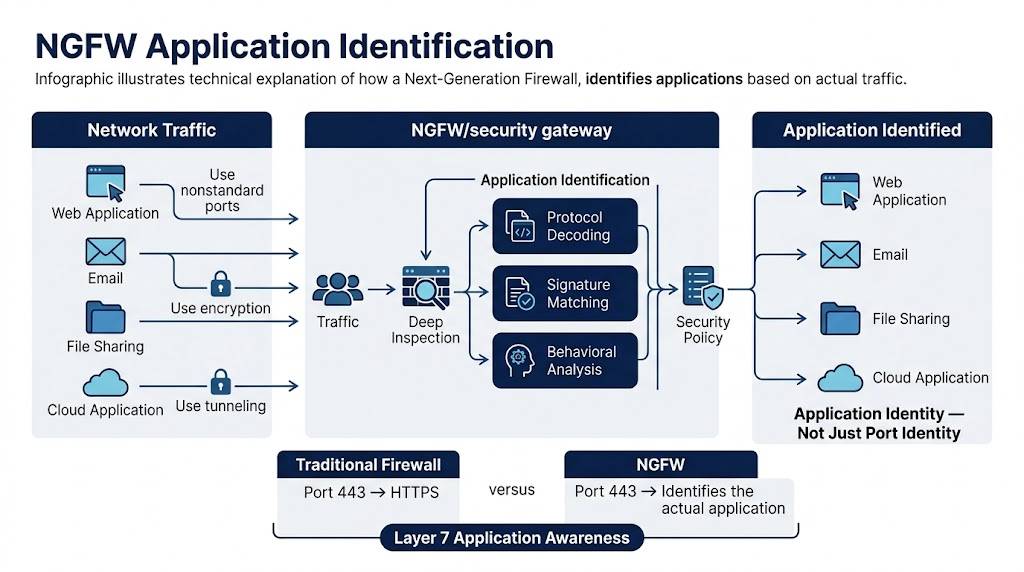
Application identification allows a Next-Generation Firewall (NGFW) to classify traffic according to the actual application instead of only the port or protocol.
This helps the firewall detect and control applications that may use encryption, tunneling, or nonstandard ports.
Application identification can use techniques such as:
- Protocol decoding
- Signature matching
- Behavioral analysis
Together, these techniques help identify applications even when they tunnel through SSL or use nonstandard ports.
User Identification
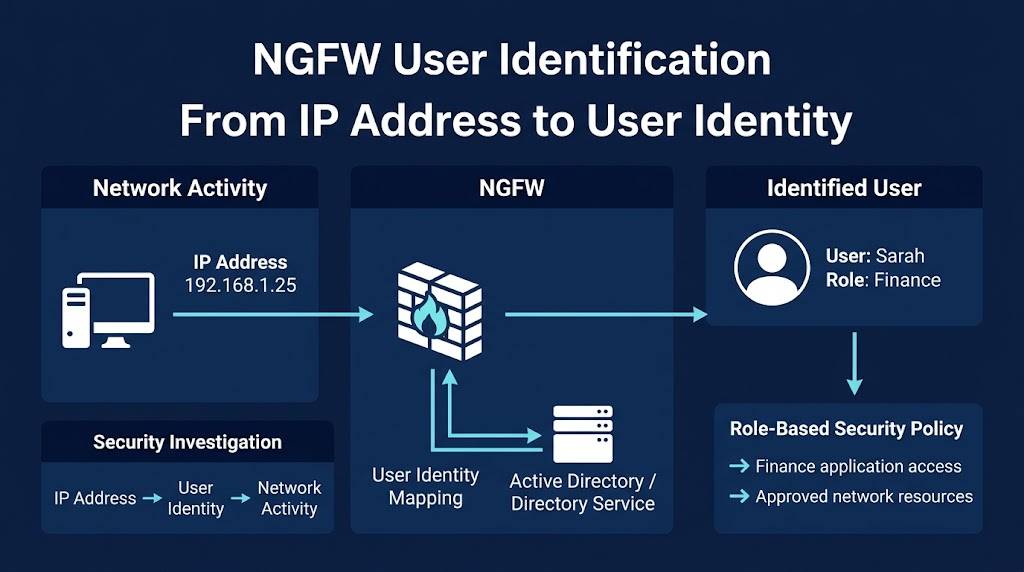
Next-Generation Firewalls (NGFWs) can map IP addresses to individual users. This allows administrators to understand who is responsible for network activity and apply policies based on identity.
Integration with directories such as Active Directory can keep user mappings updated. This supports role-based access policies and allows security events to be investigated by user rather than only by IP address.
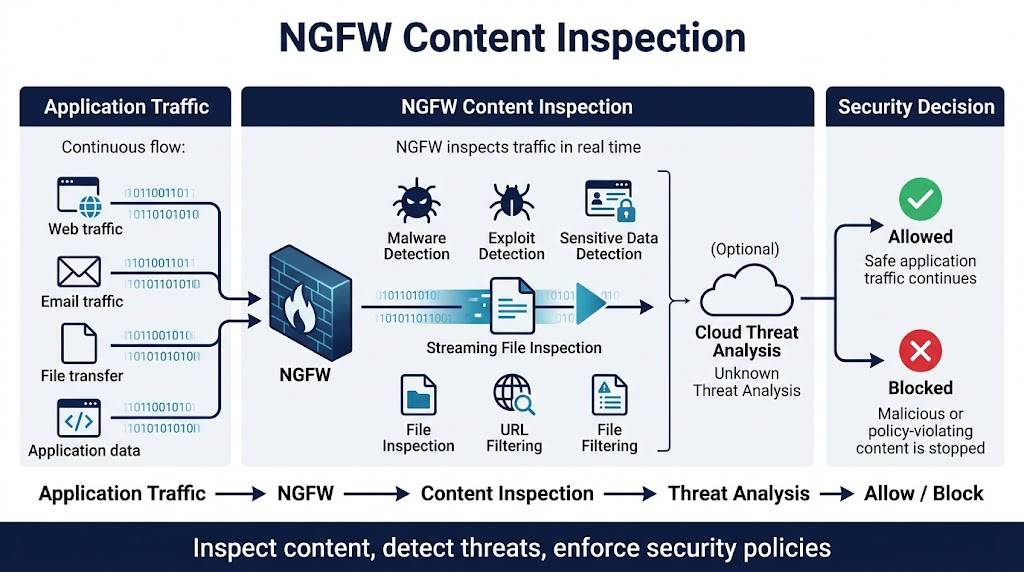
Content Inspection
Content inspection allows a Next-Generation Firewall (NGFW) to identify and block threats within application traffic.
This can include scanning for:
- Malware
- Exploit attempts
- Sensitive data
A Next-Generation Firewall (NGFW) can inspect files while they are streaming instead of waiting for a complete download. Some solutions also use cloud-based services to analyze unknown threats and enforce URL and file filtering policies.
Granular Policy Enforcement
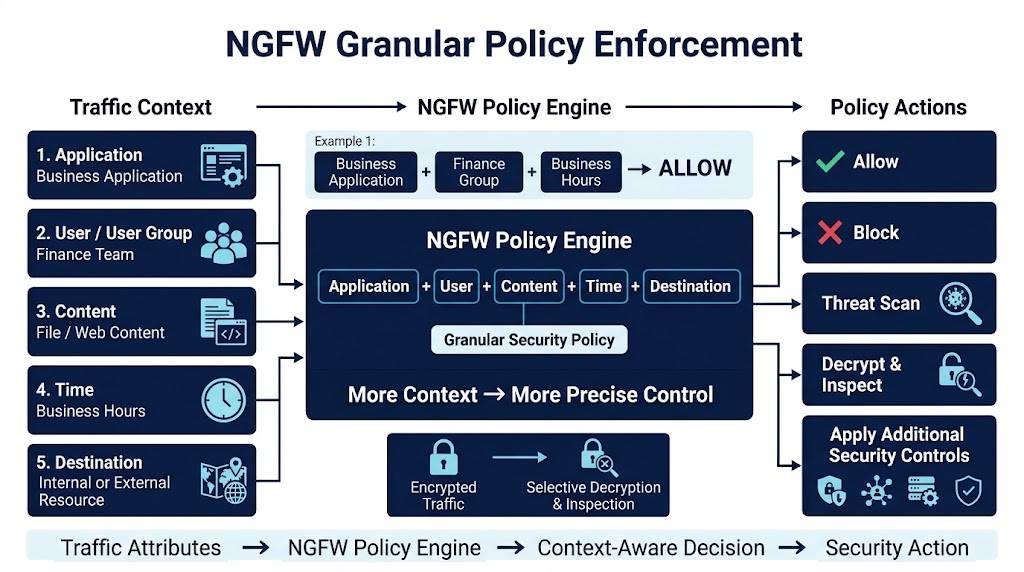
A Next-Generation Firewall (NGFW) goes beyond basic allow-or-block decisions.
After traffic has been identified by application, user, and content, administrators can apply more precise controls.
For example, a Next-Generation Firewall (NGFW) may permit an application only for a particular user group or block it during specific hours. Threat scanning and decryption can also be applied selectively according to traffic type or destination.
SSL Decryption
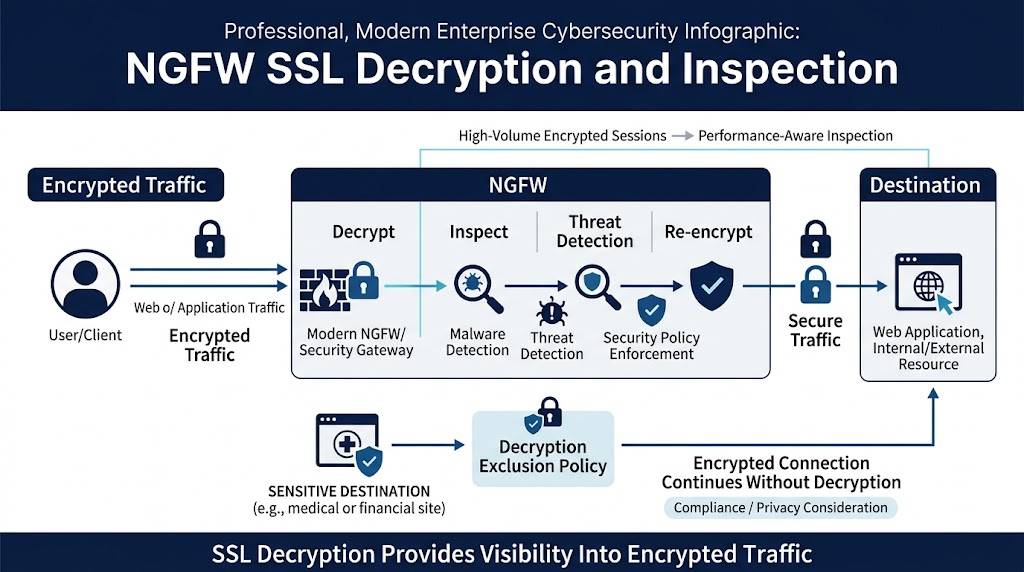
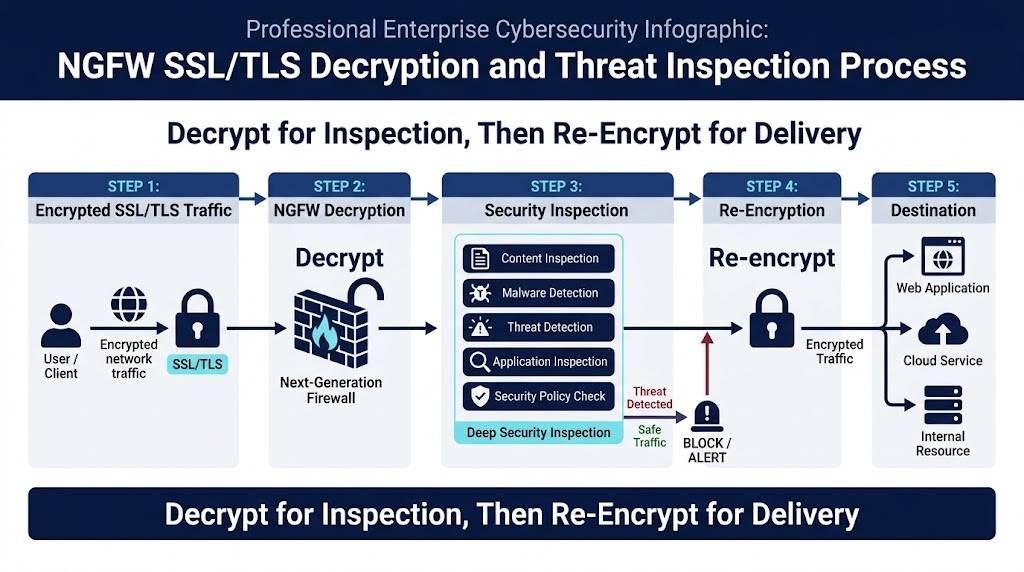
A Next-Generation Firewall (NGFW) can inspect encrypted traffic through SSL decryption.
This can expose threats that would otherwise remain hidden.
An effective Next-Generation Firewall (NGFW) can handle large volumes of encrypted sessions while minimizing performance impact. Some also allow decryption policies to exclude sensitive destinations for compliance reasons.
Single-Pass Architecture
Performance is important when deep inspection is enabled.
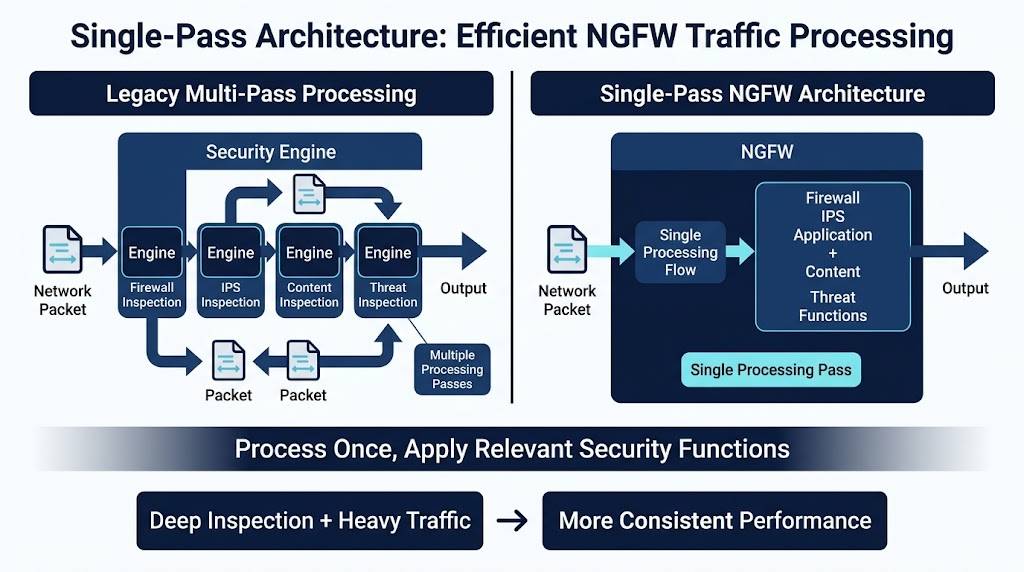
With single-pass architecture, a Next-Generation Firewall (NGFW) processes each packet once while applying the relevant security functions in the same flow.
This differs from legacy approaches where traffic may be processed multiple times through separate security engines.
The result is more consistent performance under heavy loads.
Modern NGFW Features
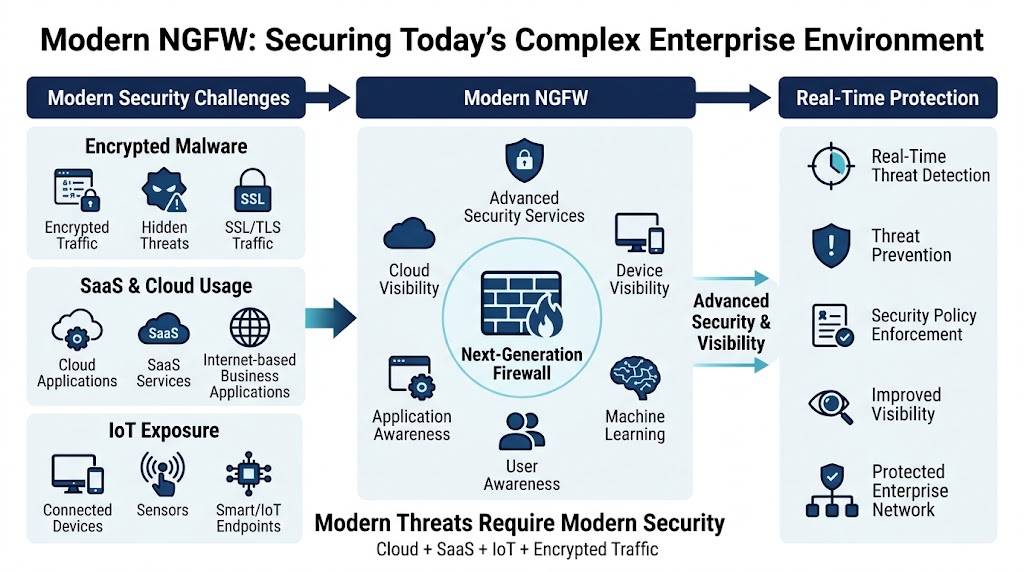
Modern Next-Generation Firewalls (NGFWs) extend the core capabilities of earlier NGFW technology.
As threats and enterprise environments became more complex, Next-Generation Firewalls (NGFWs) expanded to address challenges such as encrypted malware, SaaS usage, and IoT exposure.
Modern Next-Generation Firewalls (NGFWs) can integrate advanced security services, provide greater visibility into cloud and device behavior, and use machine learning for real-time threat detection and prevention.
Advanced Threat Prevention
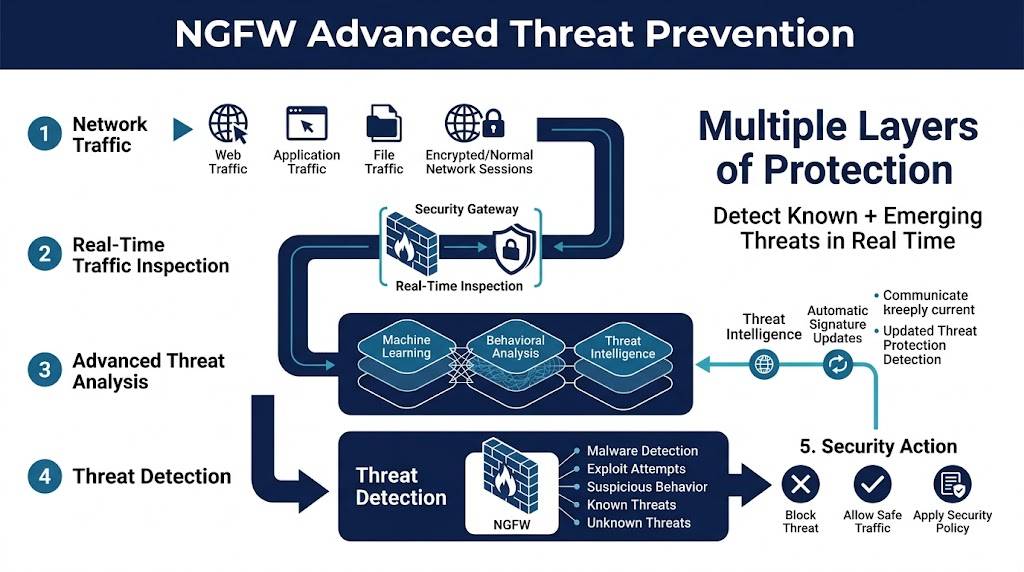
A Next-Generation Firewall (NGFW) uses multiple layers of protection to address known and unknown threats.
This includes:
- Real-time traffic inspection
- Machine learning
- Behavioral analysis
These capabilities can help detect malware and exploit attempts as they occur.
Modern Next-Generation Firewalls (NGFWs) can also use threat intelligence and automatic signature updates to stay current with changing threats.
Advanced URL Filtering
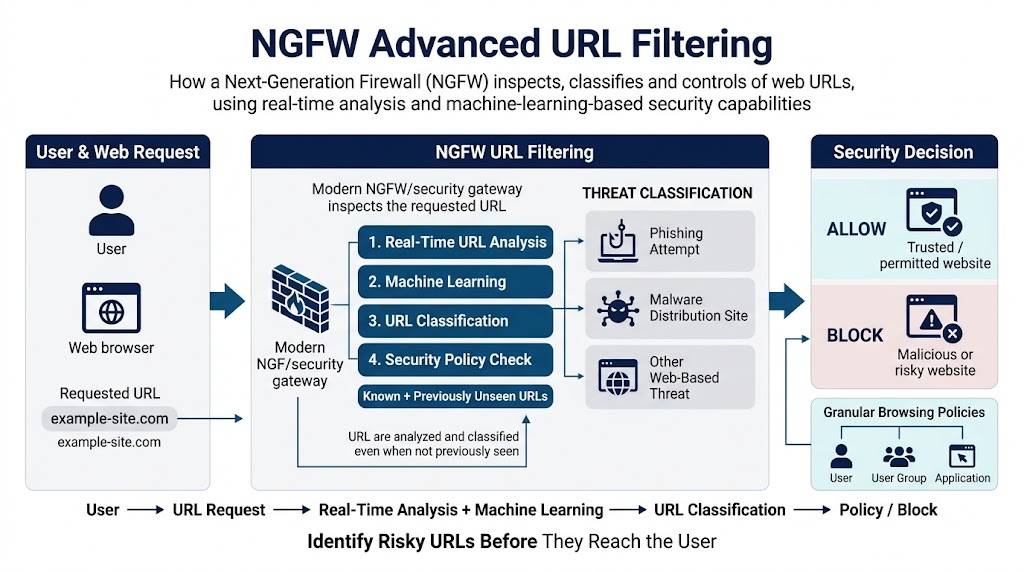
Advanced URL filtering can block malicious and risky websites.
It can use real-time analysis and machine learning to inspect and classify URLs, including URLs that have not previously been seen.
This can help identify:
- Phishing attempts
- Malware distribution sites
- Other web-based threats
It can also support granular browsing policies based on users, groups, or applications.
DNS Security
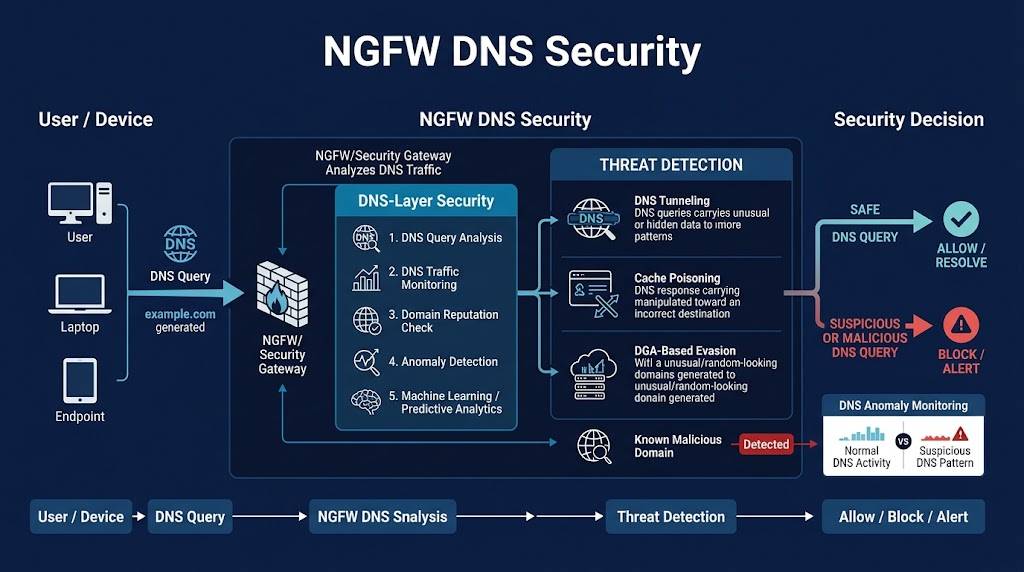
DNS security analyzes and controls DNS queries.
It can help protect against:
- DNS tunneling
- Cache poisoning
- Domain generation algorithm (DGA)-based evasion
A Next-Generation Firewall (NGFW) with DNS security can monitor DNS traffic for anomalies and known malicious domains. Some solutions use predictive analytics and machine learning to identify threats at the DNS layer.
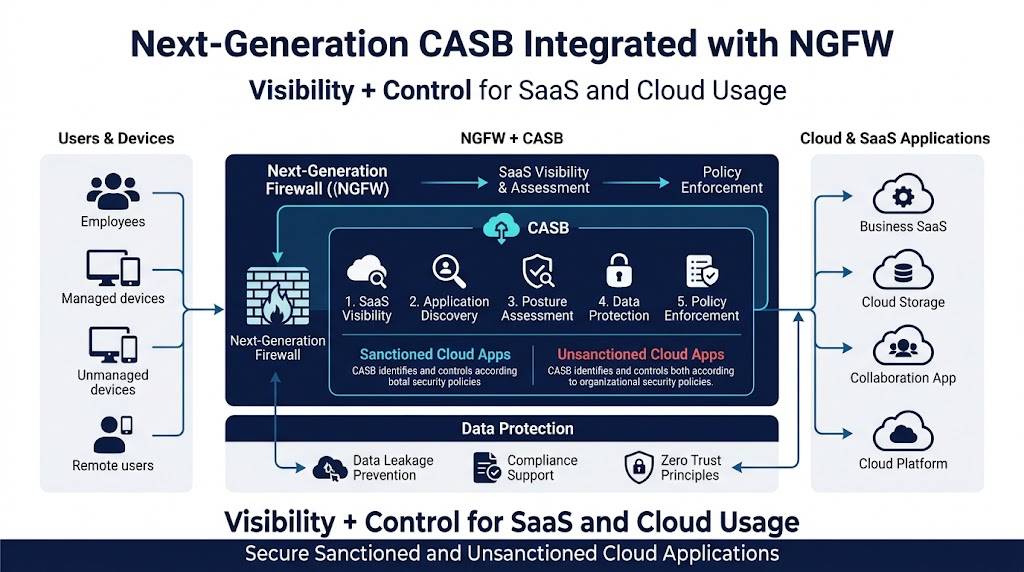
Next-Generation CASB
A next-generation cloud access security broker (CASB) integrated into a Next-Generation Firewall (NGFW) provides visibility and control over SaaS usage.
It can help secure both sanctioned and unsanctioned cloud applications.
It can also provide posture assessments, data protection, and policy enforcement. This supports data-leakage prevention, compliance, and Zero Trust principles in cloud environments.
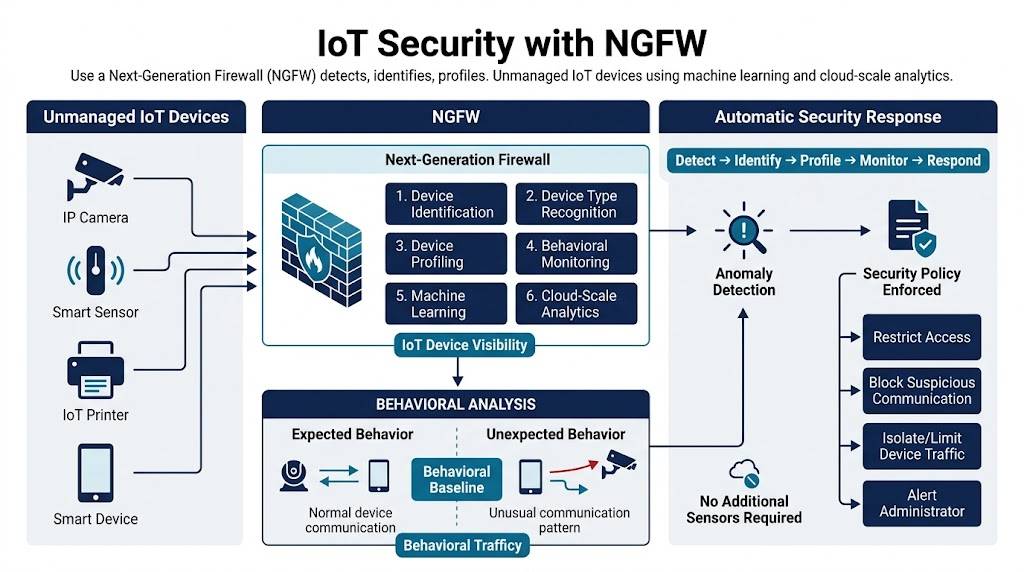
IoT Security
A Next-Generation Firewall (NGFW) can detect, identify, and secure unmanaged IoT devices.
Using machine learning and cloud-scale analytics, they can recognize device types, create profiles, and monitor device behavior.
When a device moves away from its expected baseline, the firewall can automatically enforce a security policy. This can reduce risks associated with vulnerable or misconfigured devices without requiring additional sensors.
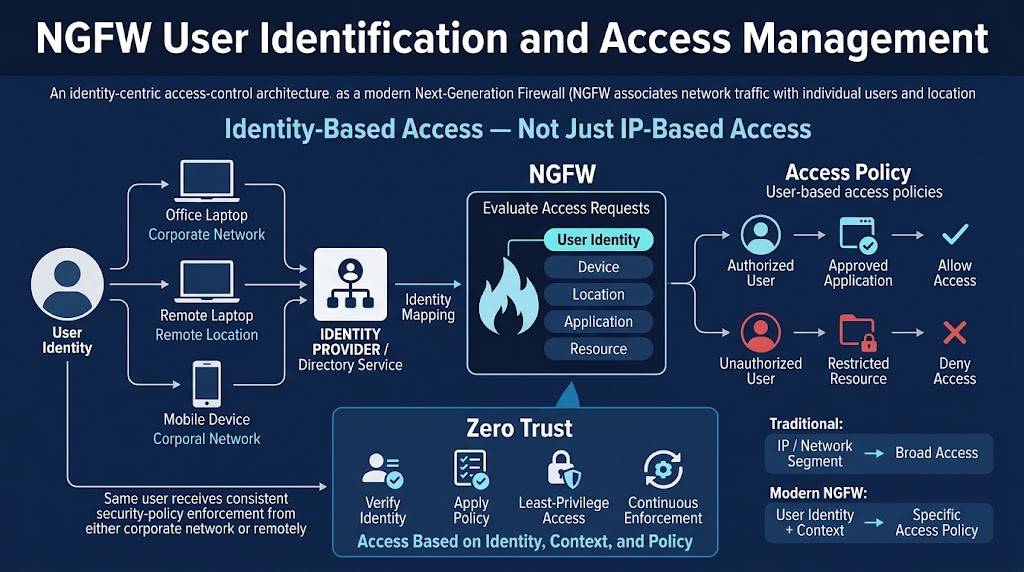
User Identification and Access Management
Modern Next-Generation Firewalls (NGFWs) can associate traffic with specific users instead of only IP addresses.
They can integrate with identity providers to map identities across devices and locations.
This enables user-based access policies and consistent enforcement for remote users. It also supports Zero Trust principles by connecting permissions to individual users rather than broad network segments.
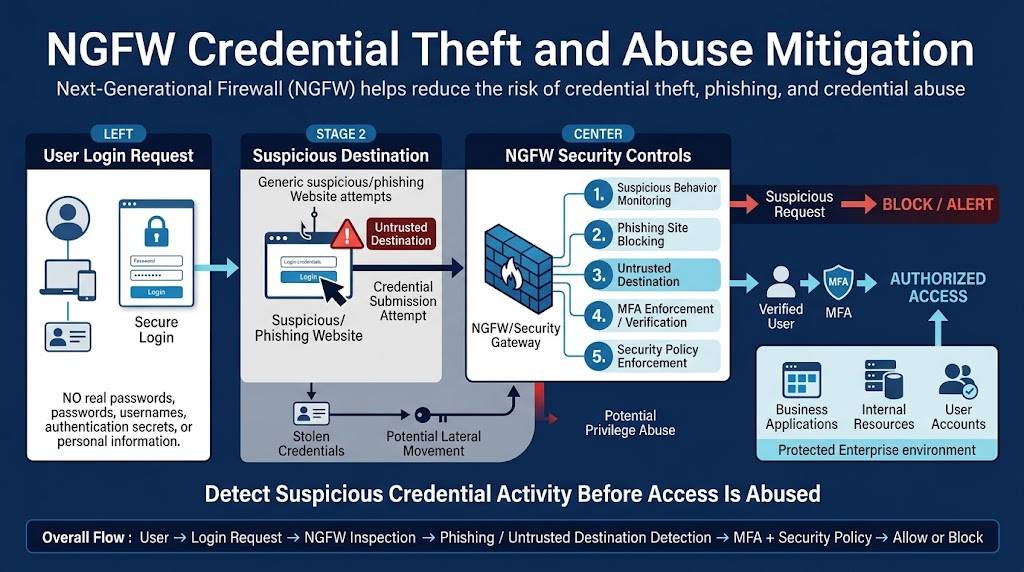
Credential Theft and Abuse Mitigation
A Next-Generation Firewall (NGFW) can help prevent credential-based attacks by monitoring suspicious behavior, enforcing multifactor authentication (MFA), and blocking known phishing sites.
They can also identify attempts to submit credentials to untrusted destinations.
This can help prevent attackers from using stolen credentials to move laterally or escalate privileges.
Application and Control Function Safety
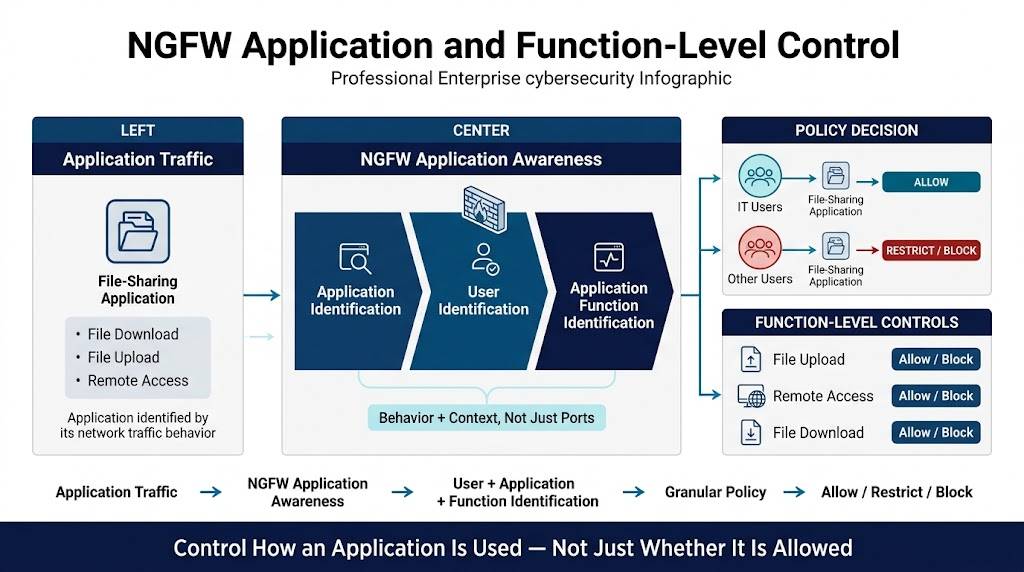
Application awareness allows a Next-Generation Firewall (NGFW) to identify traffic according to application behavior rather than only ports and protocols.
This helps distinguish between safe and risky uses of an application.
For example, a file-sharing application could be allowed for IT users while being blocked for other users.
A Next-Generation Firewall (NGFW) can also control specific application functions, including file uploads or remote access.
Encrypted Traffic Security
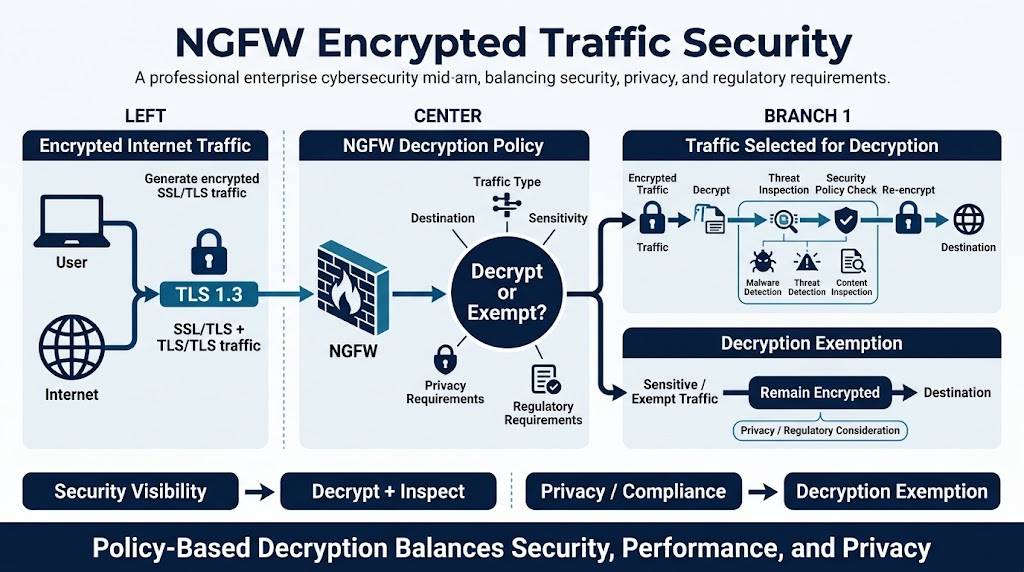
Much internet traffic is encrypted, so a Next-Generation Firewall (NGFW) needs to inspect encrypted traffic while considering performance and privacy.
A Next-Generation Firewall (NGFW) can apply policy-based decryption to SSL/TLS traffic, including TLS 1.3.
Administrators can choose which traffic should be decrypted and which traffic should be exempt based on sensitivity or regulatory requirements.
After traffic is decrypted, it can be inspected for threats and then re-encrypted for delivery.
Management Centralization and Security Capability Integration
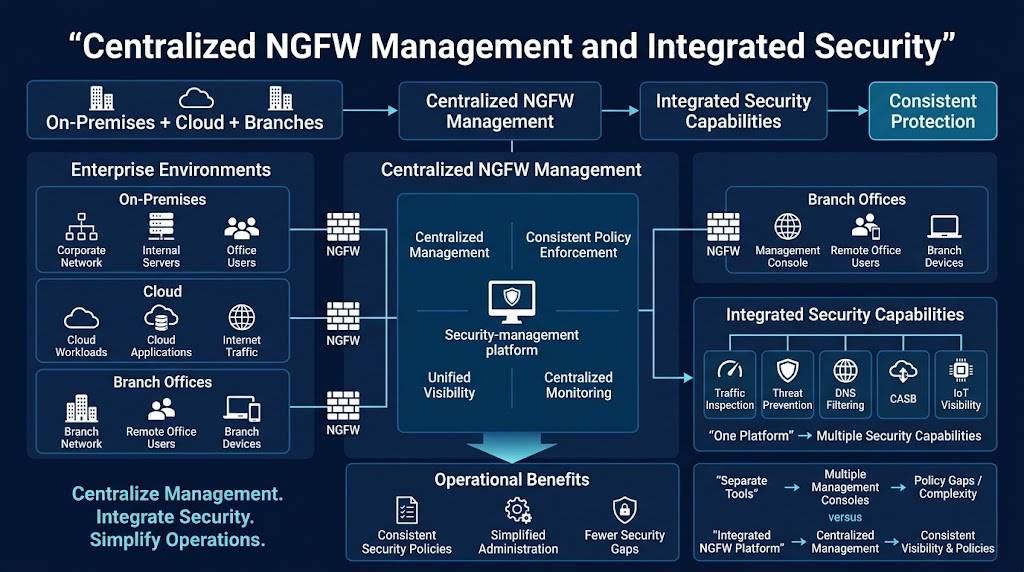
A Next-Generation Firewall (NGFW) can provide centralized management across on-premises, cloud, and branch deployments.
This helps maintain consistent policy enforcement and visibility across environments.
A Next-Generation Firewall (NGFW) can combine traffic inspection, threat prevention, DNS filtering, CASB, and IoT visibility in one platform.
This reduces dependence on separate tools, simplifies administration, and reduces the possibility of gaps between individual security products.
6. What Are the Benefits of an NGFW?
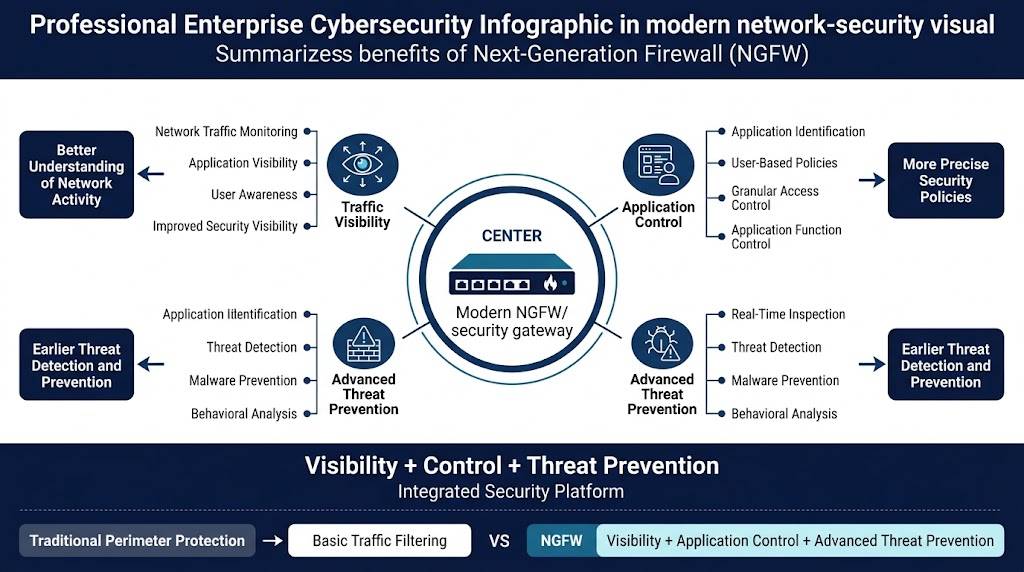
A Next-Generation Firewall (NGFW) provides more than perimeter protection. It combines traffic visibility, application control, and advanced threat prevention within one security platform.
Improved Visibility and Control
Traditional firewalls focus mainly on IP addresses, ports, and protocols.
NGFWs shift the focus toward:
- Applications
- Users
- Content
This gives administrators more useful visibility into which applications are running, who is using them, and what content is being transmitted.
Policies can therefore be based on business context rather than only technical attributes.
Better Alignment With Business Needs
Next-Generation Firewalls (NGFWs) can help IT teams support business requirements while maintaining security controls.
For example, instead of completely blocking a cloud storage application, access can be limited to specific users or risky functions such as file sharing.
This allows organizations to use required tools while maintaining control over their use.
Stronger Protection Against Modern Threats
Modern attacks can target applications, hide inside encrypted traffic, and use changing techniques to avoid detection.
Next-Generation Firewalls (NGFWs) address these challenges through real-time inspection, behavioral analysis, and threat intelligence from cloud-based sources.
This can help identify threats that have not previously been seen, including zero-day exploits and targeted malware.
Security Without Sacrificing Performance
Security functions can introduce latency when they are not designed to scale.
A Next-Generation Firewall (NGFW) can process multiple inspection and control functions in a single pass instead of sending traffic through separate engines.
This can reduce processing time and maintain performance during high traffic volumes or heavy use of encrypted connections.
Simplified Infrastructure and Management
A Next-Generation Firewall (NGFW) can consolidate multiple security functions into one platform.
These may include:
- URL filtering
- IPS
- DNS security
- CASB
This reduces the number of separate tools that security teams need to manage and can reduce policy sprawl, configuration errors, and gaps between products.
Centralized management can also help maintain consistent policies across on-premises, remote, and cloud environments.
Consistent Protection Across Locations
Next-Generation Firewalls (NGFWs) can apply consistent policies to users regardless of their location.
This includes users working:
- Remotely
- In branch offices
- On mobile devices
Extending inspection and control beyond the traditional network perimeter helps reduce security gaps in distributed and hybrid environments.
Support for Zero Trust Security Models
A Next-Generation Firewall (NGFW) can support Zero Trust principles by verifying users, devices, and applications before granting access.
Rather than automatically trusting internal traffic, a Next-Generation Firewall (NGFW) can apply policy checks and use identity information such as user role, group, and behavior.
This can reduce implicit trust, limit lateral movement, and strengthen segmentation.
Operational and Cost Efficiency
By consolidating multiple security functions into one platform, a Next-Generation Firewall (NGFW) can reduce the need for separate security appliances.
Centralizing threat detection, URL filtering, and application control can mean fewer systems to license, power, maintain, and manage.
A single policy framework and management interface can also reduce administrative effort and complexity.
7. What Are the Most Common NGFW Misconceptions?
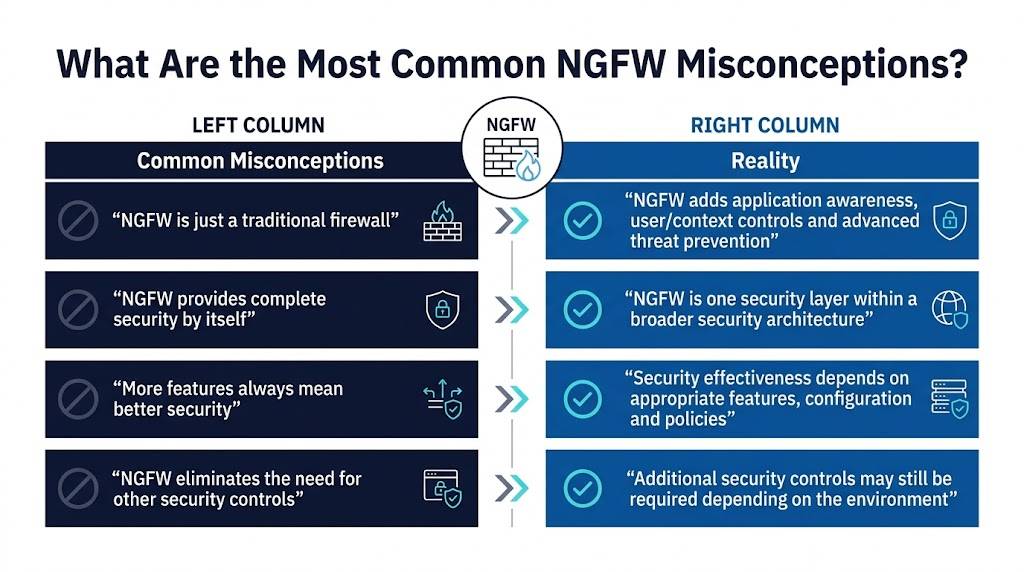
Misconception 1: An NGFW Is the Same as a UTM
Unified threat management (UTM) appliances combine multiple security functions into one device. These can include basic firewalling, antivirus, and intrusion prevention.
NGFWs provide deeper integration and context sharing across security functions. They can apply policies across applications, users, and content.
UTMs do not provide the same level of visibility or control over application behavior or user identity described for NGFWs.
Misconception 2: Proxy-Based Firewalls Offer Equivalent Protection
Proxy firewalls terminate a session and create another session on behalf of the client.
NGFWs inspect traffic inline without terminating the session. They can analyze application behavior, apply granular policies, and provide real-time threat prevention.
Note: Some environments continue to use proxy firewalls for specific purposes, such as isolating web traffic, but they are typically used together with NGFWs rather than as replacements.
Misconception 3: A WAF Can Replace an NGFW
WAFs focus on Layer 7 traffic, particularly HTTP-based applications. They look for vulnerabilities caused by coding problems or misconfigurations.
NGFWs provide broader network visibility, user mapping, encrypted traffic inspection, and advanced threat prevention.
WAFs can protect individual applications, but they do not replace the broader network protection provided by NGFWs.
Misconception 4: Vulnerability and Patch Management Is a Firewall Function
NGFWs do not replace vulnerability or patch management tools.
Vulnerability management tools scan hosts, check patch levels, and identify outdated software.
NGFWs can restrict traffic to vulnerable systems or detect exploit attempts, but they do not replace a dedicated patch management process.
Note: NGFWs can complement vulnerability management by applying compensating controls such as isolating unpatched systems or blocking known exploit traffic.
Misconception 5: NGFWs Include Full DLP
NGFWs can identify sensitive data patterns in traffic, but they do not provide the same functionality as purpose-built DLP tools.
Dedicated DLP tools provide deeper content analysis, data-use tracking, and complex data-handling policies.
NGFWs can block traffic matching specific patterns, but they do not provide the same contextual data analysis and policy enforcement.
Note: NGFWs may support regex or keyword matching for sensitive data, while full DLP involves deeper inspection of file types, context, and user intent.
Misconception 6: NGFWs Fully Replace Secure Web Gateways
Secure web gateways use URL categorization and filtering to enforce browsing policies.
Modern NGFWs often include URL filtering, but not every NGFW provides the same content filtering, isolation, or dedicated web inspection capabilities as an SWG.
NGFWs can, however, provide more consistent policy enforcement across different traffic types and protocols.
Misconception 7: NGFW Threat Intelligence Is Enough on Its Own
Many NGFWs use vendor-provided threat intelligence feeds.
These feeds are useful, but they may represent only one view of the threat landscape.
Sophisticated attackers can use evasion techniques that bypass single-source detection. Broader threat intelligence from government, open-source, and commercial sources can provide more comprehensive protection.
NGFWs without easy third-party intelligence integration may have limitations when identifying new or targeted threats.
Misconception 8: NGFWs Support Unrestricted Threat Intelligence Integration
Third-party IP or domain blocklists cannot always be loaded without limitations.
Many NGFWs have limits involving:
- List size
- Ingestion formats
- Processing capacity
- Ingestion frequency
These limits can make it more difficult to use open-source or commercial threat feeds at full scale.
Note: Even when integration is supported, processing power, ingestion frequency, and list-size limits can affect real-time effectiveness.
8. NGFW vs. Traditional Firewall
| Feature | Traditional Firewall | Next-Generation Firewall |
|---|---|---|
| Traffic control | IP addresses, ports, protocols | Applications, users, content, context |
| Application awareness | None or limited | Deep application visibility and control |
| User identification | IP-based | Identity-service integration |
| Encrypted traffic | Cannot decrypt or inspect SSL/TLS | Can decrypt, inspect, and re-encrypt |
| Threat prevention | Basic or separate | Integrated threat prevention |
| Granular control | Mainly allow/block | Function-level and time-based controls |
| Performance architecture | Multi-pass | Single-pass |
| Evasive threats | Limited visibility | Designed to detect evasive threats |
| Content inspection | Limited or add-on | Built-in filtering and threat scanning |
| Threat intelligence | Often limited | Vendor intelligence plus limited external integration |
| Management | Often multiple products | Unified platform |
| Common use case | Perimeter access control | Granular visibility and control across networks, users, and applications |
Traditional firewalls were designed around static rules based on IP addresses, ports, and protocols.
Modern applications increasingly use dynamic ports, encryption, and tunneling. NGFWs address this by analyzing application behavior and combining application identification, user identity, content inspection, and threat prevention within a unified policy model.
The result is more precise control over modern, encrypted, and evasive traffic.
9. What to Look for in an NGFW Solution
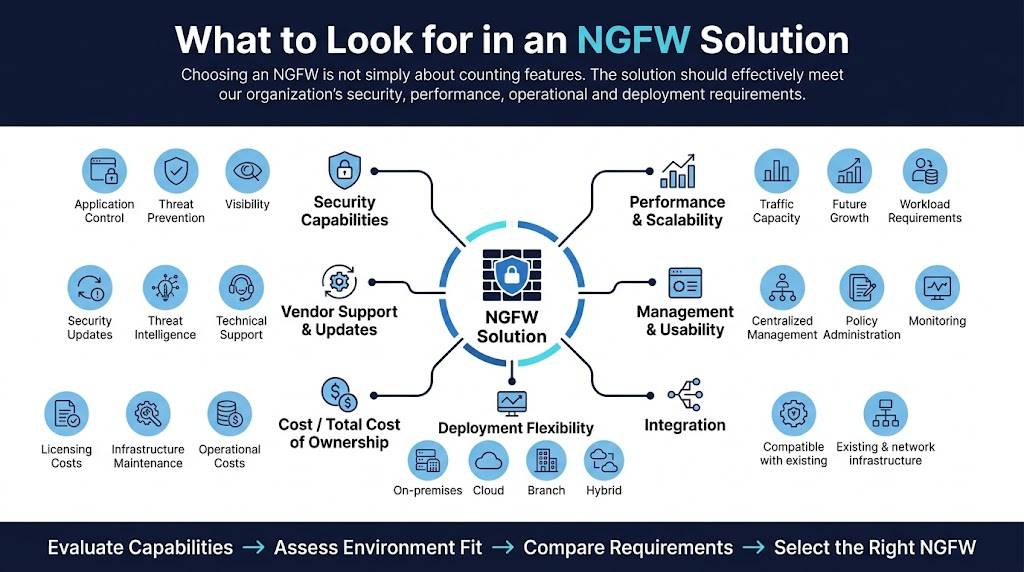
Choosing an NGFW is not only about counting available features. The important question is how effectively the solution delivers those capabilities in the target environment.
1. Consistent Performance Under Load
An NGFW should maintain low latency when security services are enabled.
Threat inspection, decryption, and logging can add processing overhead. The selected solution should handle these functions without degrading user experience or throughput.
Tip: Test threat prevention, decryption, and logging at the same time. Advertised throughput may be based on ideal conditions rather than real-world configurations
2. Centralized Policy Management
Firewall instances across on-premises and cloud environments should be manageable from one console.
This should include policy creation, log viewing, and global updates.
Tip: Evaluate how the platform handles policy shadowing and overrides across distributed deployments. Look for systems that can identify or prevent conflicting rules before deployment.
3. Operational Efficiency
Security management should not require teams to constantly move between different tools.
The firewall should simplify policy creation, automate tasks, and consolidate capabilities.
This helps teams focus on security threats instead of manual processes.
4. Cloud and Automation Readiness
An NGFW should support modern infrastructure, including public clouds, private clouds, and automation tools such as Terraform and Ansible.
Tip: Check for prebuilt integrations or modules for the infrastructure-as-code tools being used. Native modules can help speed deployment and reduce errors.
5. Scalability and Deployment Flexibility
Organizations may need NGFWs in:
- Data centers
- Branch offices
- Public clouds
The solution should support physical, virtual, and cloud-native form factors and scale as requirements grow.
6. Integration With Broader Security Ecosystems
NGFWs should integrate with identity providers, endpoint protection, threat intelligence, SIEMs, and other security tools.
This allows information to move between systems and provides a broader view of risk.
Tip: Evaluate whether the NGFW supports bidirectional integration, including sharing enriched threat and traffic context back to SIEM or SOAR platforms.
7. Licensing and Total Cost of Ownership
Different vendors package NGFW features differently.
Some capabilities may be included in the base license while others may require separate licensing.
Understand what each license tier includes and ensure the pricing model supports long-term requirements.
Tip: Request a breakdown of each license tier and understand what happens when features are disabled for cost reasons.
10. How to Successfully Deploy NGFWs in 11 Steps
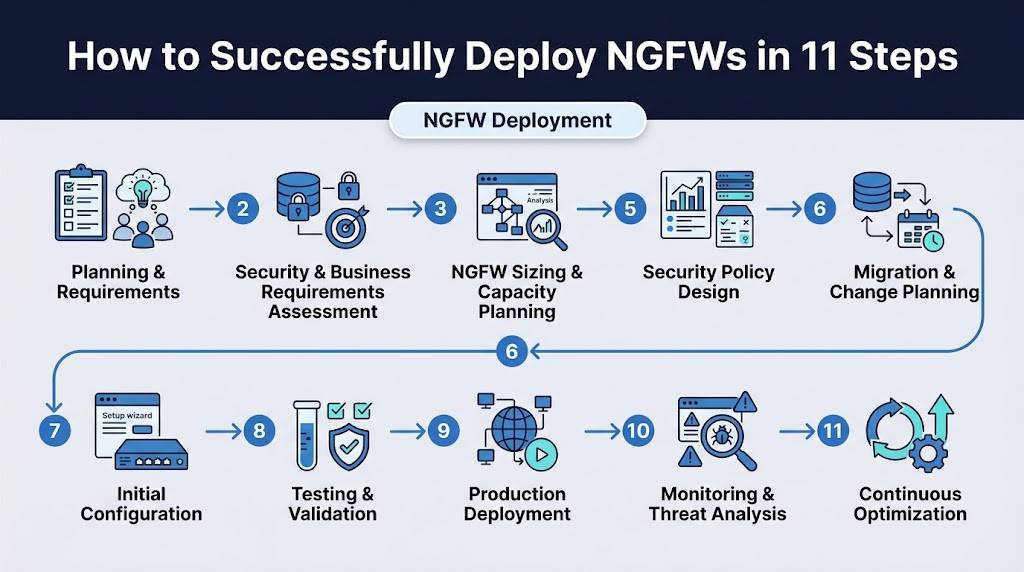
Deploying an NGFW is not simply a matter of putting the device online.
It requires planning, policy alignment, architecture decisions, and long-term operational preparation.
Step 1: Align With Current Security Policies
Start with policy.
The deployment should reflect the organization’s existing acceptable-use requirements and risk tolerance.
If policies are outdated or unclear, update them before working with the firewall.
Tip: Include application-specific use cases such as acceptable cloud-storage or remote-access usage so the NGFW can enforce policies beyond simple IP controls
Step 2: Define Technical and Operational Requirements
Document functional and administrative network requirements.
This includes:
- Network segmentation goals
- Remote access scenarios
- Integration requirements across teams
Step 3: Select Appropriate Network Locations
NGFW placement matters.
Some environments require perimeter enforcement, while others may prioritize internal segmentation.
Choose locations that match the traffic requiring inspection and the risks that need to be managed.
Step 4: Plan for Segmentation
Segment the network logically to isolate sensitive systems, reduce lateral movement, and enforce policy boundaries.
Use zones that reflect:
- Business function
- Sensitivity
- Trust level
Tip: Avoid excessive segmentation that adds complexity without meaningful isolation. Focus on high-risk systems, regulated data, or untrusted user groups.
Step 5: Map Out Remote and Branch Connectivity
Include remote users and branch offices in the design.
The deployment should provide consistent enforcement regardless of user location.
Tip: Ensure policies can still be enforced when users connect through VPN or cloud-based access gateways.
Step 6: Support Dynamic Environments
Modern environments change frequently.
This includes:
- Virtual machines
- Containers
- Cloud workloads
The deployment model should handle these changes without requiring frequent reconfiguration.
Step 7: Build Governance Into the Rollout
Involve stakeholders from:
- IT
- HR
- Compliance
There should be shared ownership of decisions involving user access, acceptable use, and escalation paths.
Step 8: Document Configuration Standards
Establish configuration standards before deployment.
These should include:
- Naming conventions
- Baseline rule sets
- Change-control procedures
- Logging practices
Tip: Document the reasons for rule exceptions. This can help with future audits and troubleshooting.
Step 9: Validate Before Production Cutover
Test the deployment in a lab or staging environment using representative traffic.
Validate:
- Policy logic
- Administrative workflows
- Interoperation with other tools
This helps reduce the risk of misconfiguration during rollout.
Step 10: Monitor and Adjust Post-Deployment
Continuously monitor the firewall after deployment.
Track:
- Rule effectiveness
- Policy violations
- Unexpected traffic behavior
Use this information to refine the configuration over time.
Step 11: Prepare for Long-Term Maintenance
An NGFW is not a set-and-forget system.
Assign ongoing responsibility for:
- Updates
- Rule reviews
- Audit readiness
Ensure the team has the access and training required to manage the deployment over the long term.
11. How Do NGFWs Compare With Other Security Technologies?
NGFWs complement, differ from, and sometimes overlap with other security technologies.
NGFW vs. WAF
NGFWs and web application firewalls protect different areas of traffic.
NGFWs inspect network-layer traffic, often at Layers 3 and 4 and sometimes Layer 7.
WAFs focus on HTTP traffic at Layer 7, specifically to protect web applications.
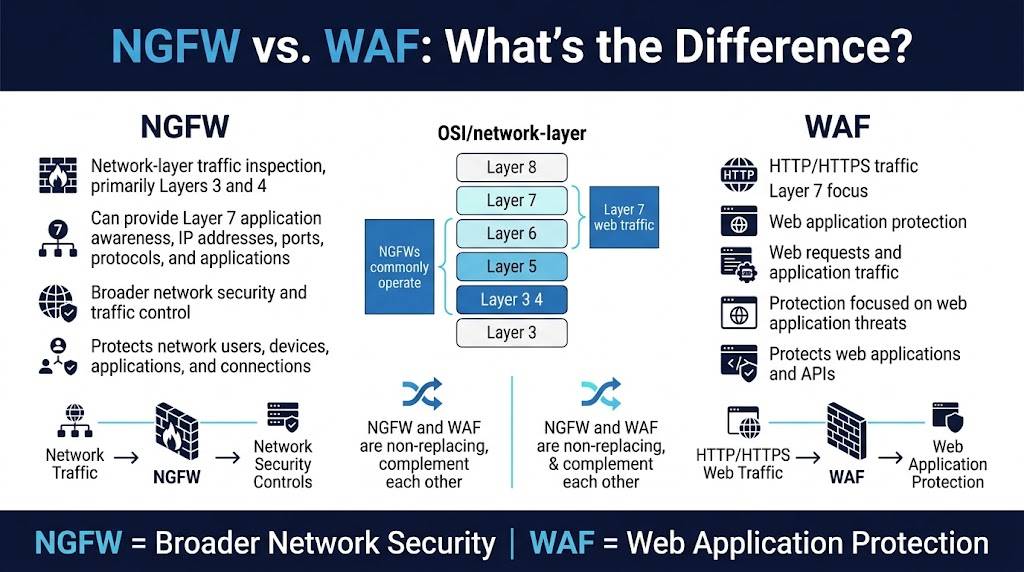
An NGFW may block malicious inbound network traffic, but it does not replace the role of a WAF in protecting a specific web form against application-level attacks.
NGFWs help control general application access, while WAFs analyze application behavior during active use.
The teams managing them may also differ. NGFWs are generally managed by network security teams, while WAF policies may require application-development input because they depend on application logic.
NGFW vs. UTM
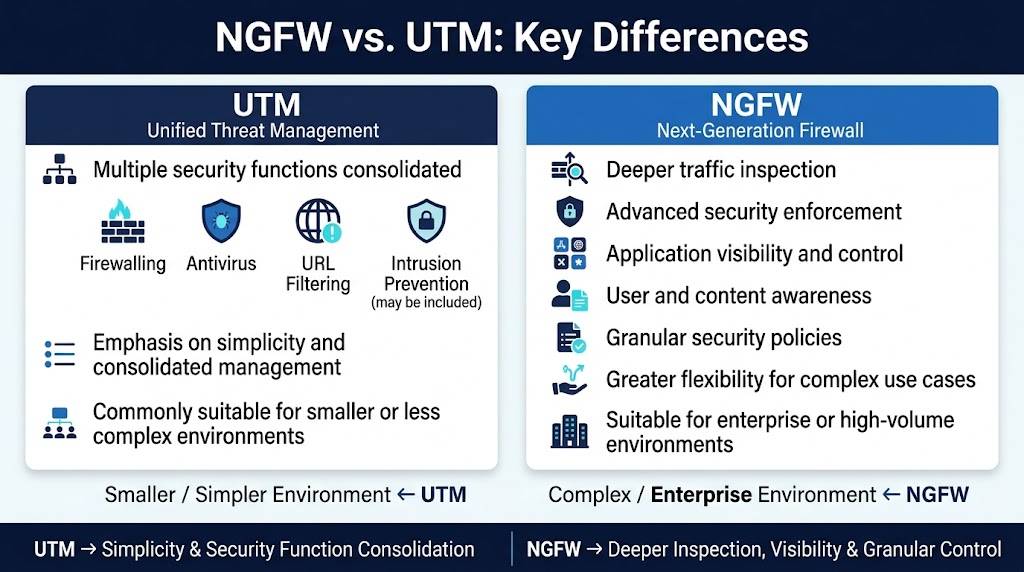
UTM and NGFW technologies can appear similar because both can combine multiple security functions.
UTMs generally consolidate functions such as:
- Firewalling
- Antivirus
- URL filtering
- Sometimes intrusion prevention
They are typically designed for smaller environments and emphasize simplicity.
NGFWs focus on deeper inspection and advanced security enforcement. They provide granular visibility into applications, users, and content and are suited to enterprise or high-volume environments.
NGFWs also provide more flexibility for specific use cases and complex environments.
NGFW vs. FWaaS
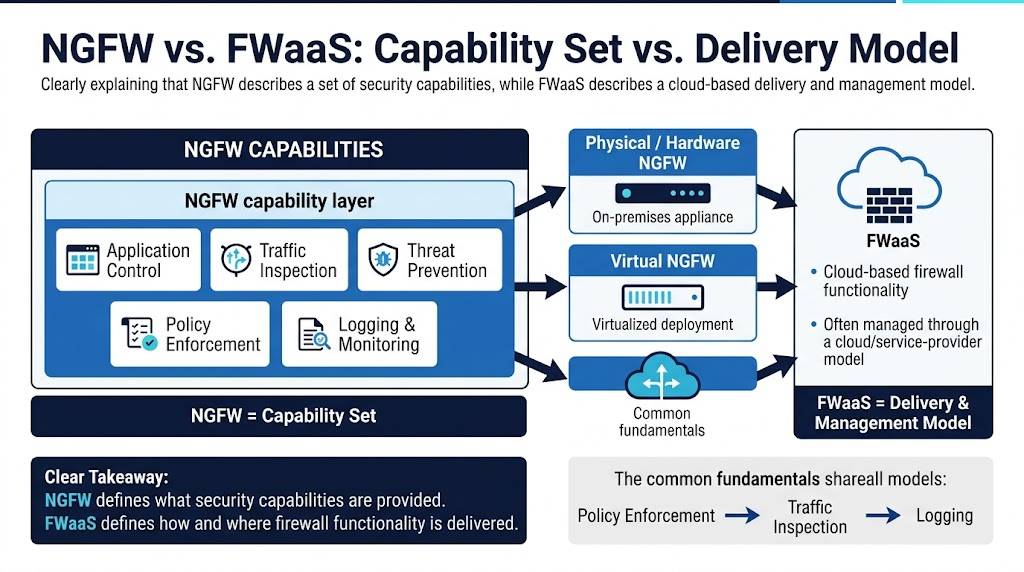
Firewall-as-a-Service (FWaaS) is a deployment model in which firewall capabilities are delivered from the cloud.
NGFW describes a set of capabilities.
Therefore, a FWaaS deployment can use NGFW capabilities.
The key difference is deployment and management:
- Traditional NGFWs are often physical or virtual appliances.
- FWaaS moves firewall functionality to a cloud-based model, often managed by a service provider.
FWaaS can be useful for distributed workforces or organizations with significant cloud adoption.
However, the fundamentals remain the same: the firewall must enforce policies, inspect traffic, and log activity.
Key distinction: FWaaS is a delivery method, while NGFW is a capability set.
NGFW vs. Network Firewall
A network firewall filters traffic between trusted internal networks and untrusted external networks.
It typically inspects packets and applies rules based on:
- IP addresses
- Ports
- Protocols
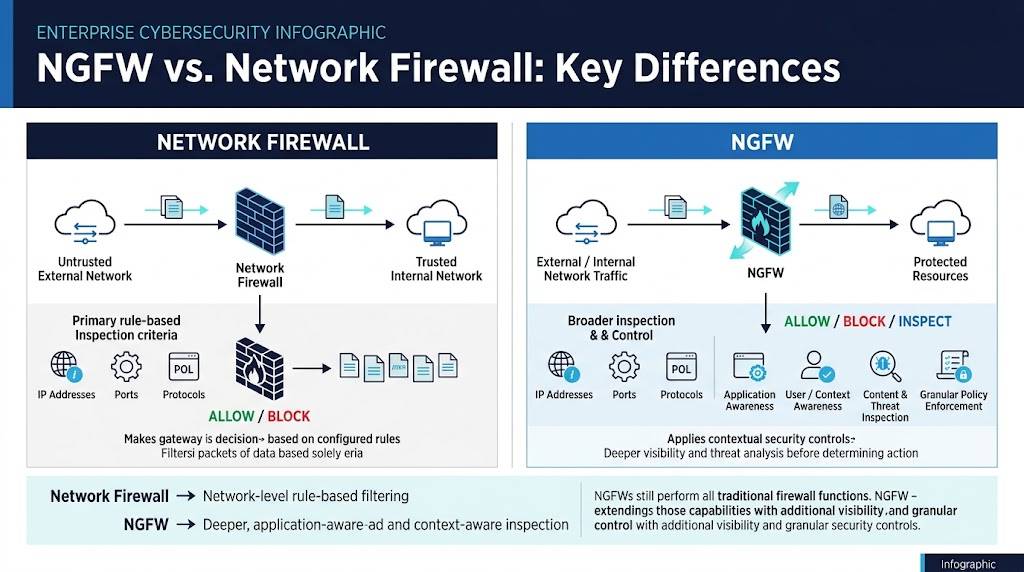
NGFWs build on these traditional firewall capabilities.
They add deeper traffic analysis, application awareness, user identification, and integrated threat prevention.
In simple terms, network firewalls control traffic at the perimeter, while NGFWs add context based on the user, application, and potential threat.
NGFWs can therefore be viewed as the next evolution of network firewalls.
Lorem ipsum dolor sit amet, consectetur adipiscing elit. Ut elit tellus, luctus nec ullamcorper mattis, pulvinar dapibus leo.
FAQs
What Does NGFW Mean?
NGFW stands for Next-Generation Firewall.
An NGFW is a security device that inspects traffic by application, user, and content. It combines traditional firewall capabilities with intrusion prevention and threat detection for deeper, context-aware enforcement.
What Are Typical Functions of Next-Generation Firewalls?
The source identifies application identification, user identification, content inspection, granular policy enforcement, SSL decryption, advanced threat prevention, URL filtering, DNS security, CASB, IoT security, and centralized security capabilities among NGFW functions.
Which Network Layer Do NGFWs Work On?
NGFWs inspect traffic beyond basic IP addresses and ports and can inspect traffic at higher OSI layers, including the application layer and Layer 7.
Are NGFWs Signature-Based or Behavior-Based?
The source describes both signature-based and behavioral techniques. Application identification can use protocol decoding, signature matching, and behavioral analysis, while modern NGFWs can use machine learning and behavioral analysis for threat prevention.
Do NGFWs Have Intrusion Prevention Built In?
Yes. The source describes NGFWs as combining traditional firewall capabilities with integrated intrusion prevention and threat detection.
What NGFW Feature Supports Inspection of SSL-Based Traffic?
SSL decryption allows an NGFW to inspect encrypted traffic and identify threats that could otherwise remain hidden.