Zero Trust vs Traditional Security: 8 Key Differences
Description
Compare zero trust vs traditional security across trust, access control, IAM, adaptability, and device security, plus benefits and real-world use cases.
Scope
This guide explains the difference between the zero trust security model and the traditional security model. It covers their trust assumptions, network access controls, identity and access management, adaptability, and device trust.
It also explains the similarities between the two approaches, the benefits of zero trust, a side-by-side comparison, and practical use cases across IT services, healthcare, and FinTech.
The content is intended for both beginners who want to understand zero trust and security professionals comparing modern access controls with traditional perimeter-based security.
1. What Is a Zero Trust Security Model?
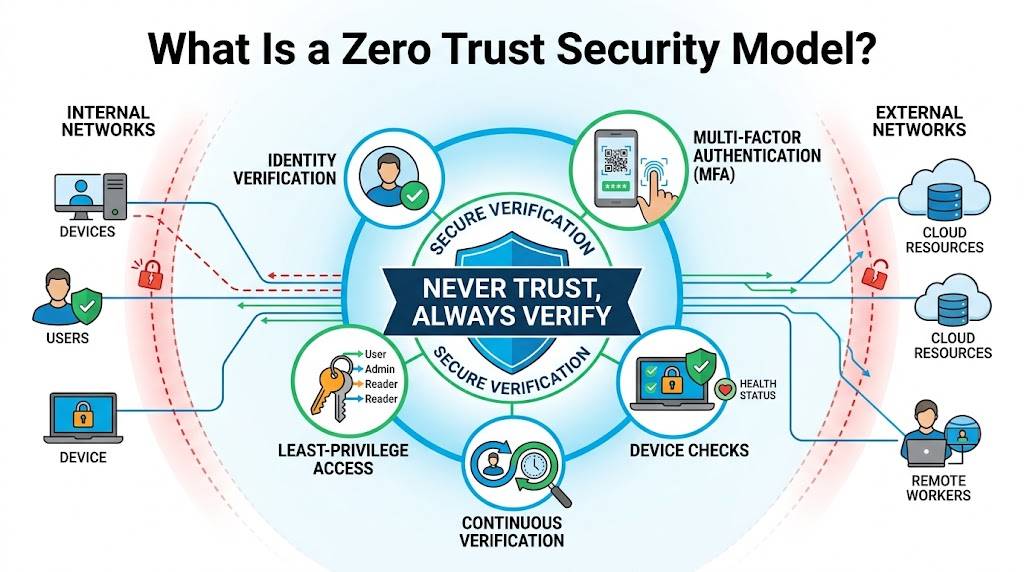
Zero trust security is a cybersecurity approach based on the principle “never trust, always verify.” It assumes that both internal and external networks could be compromised.
Instead of automatically trusting users or devices because they are inside a network, zero trust verifies access continuously. It uses identity verification, multi-factor authentication (MFA), device checks, and least-privilege access to ensure that only authenticated and authorized users can access critical resources.
This approach is especially relevant to modern IT environments that use cloud infrastructure, mobile devices, and remote work. Zero trust extends security beyond the traditional network perimeter and focuses on protecting users, devices, applications, and resources.
This principle also aligns with the NIST definition of zero trust architecture, which states that trust should not be granted simply because of a user’s or device’s physical or network location.
2. Zero Trust Security vs Traditional Perimeter Security: Key Differences
Traditional security models are primarily built around a network perimeter. They assume that threats are mainly external and use boundary defenses to keep attackers outside.
However, remote work, cloud infrastructure, mobile devices, and decentralized environments make a fixed security boundary less effective. Zero trust takes a different approach by continuously verifying users, devices, and applications instead of relying primarily on network location.
Here are five key differences between zero trust and traditional security models.
1. Trust Assumptions
Traditional Security Model
- Assumes that anything inside the network is trustworthy.
- Once a user or device enters the network, they may receive broad access to internal resources.
- If an attacker breaches the perimeter, this implicit trust can create significant security risks.
Zero Trust Security Model
- Assumes that no user or device, whether inside or outside the network, is trustworthy by default.
- Every access request must be verified regardless of where it originates.
- Continuous monitoring prevents trust from becoming implicit and makes it harder for attackers to move through the environment undetected.
Key principle: Never Trust, Always Verify.
This principle is central to zero trust. NIST similarly describes zero trust as an approach that removes implicit trust based on network location and requires explicit authentication and authorization.
2. Network Access Control
Traditional Security Model
- Relies on perimeter defenses such as firewalls and VPNs to restrict external threats.
- Once users or devices are inside the perimeter, they generally face fewer restrictions.
- If the boundary is breached, over-privileged access can increase the potential impact of an attack.
Zero Trust Security Model
- Uses granular access control based on factors such as the user’s role, resource sensitivity, and contextual information.
- Continuously monitors access and can adjust permissions based on real-time information.
- Gives users access only to the resources they need.
Granular access control:
In a zero trust model, access is not simply all-or-nothing. Access is tailored according to network segmentation, user context, role, and need.
3. Identity and Access Management (IAM)
Traditional Security Model
- Focuses on authenticating users when they initially enter the network.
- After authentication, users may receive broad access to internal systems.
- If an attacker compromises one entry point, they may gain extensive access across the network.
Zero Trust Security Model
- Applies identity and access management continuously to ensure that only authorized users can access specific resources.
- Uses least-privilege access so users receive only the access required to perform their tasks.
- IAM policies can adapt in real time based on user behavior, location, or device health.
Least privilege:
A key zero trust principle that limits users to the resources they actually need, helping reduce the potential attack surface.
4. Flexibility and Adaptability
Traditional Security Model
- Often relies on a fixed perimeter to protect data.
- Cloud services, remote workers, and IoT devices can exist outside the established perimeter.
- This can create security gaps because traditional perimeter models were not designed around highly decentralized environments.
The source article cites a 2021 Cisco report stating that 76% of organizations considered their traditional perimeter-based security model ineffective for securing remote employees.
Zero Trust Security Model
- Is designed to support modern organizational environments.
- Supports cloud infrastructure, hybrid environments, and mobile workforces.
- Maintains security regardless of device location.
- Provides protection for employees accessing resources remotely or through cloud services.
NIST likewise describes zero trust as a response to environments involving remote users, BYOD, and cloud-based assets outside traditional enterprise boundaries.
5. Device Trust
Traditional Security Model
- Assumes devices inside the network are trusted once they enter the perimeter.
- Grants access largely according to device location and relies on network security tools such as firewalls and VPNs.
- Focuses heavily on external threats.
- Can overlook internal threats and changing device environments such as hybrid, cloud, and mobile environments.
Zero Trust Security Model
- Does not trust devices automatically, regardless of whether they are inside or outside the network.
- Continuously verifies and authenticates devices to ensure they meet security requirements.
- Applies least privilege so devices receive only the resources necessary for operation.
This device-focused approach supports modern environments where users and devices may connect from different locations and networks.
3. Similarities Between Zero Trust Security and Traditional Security
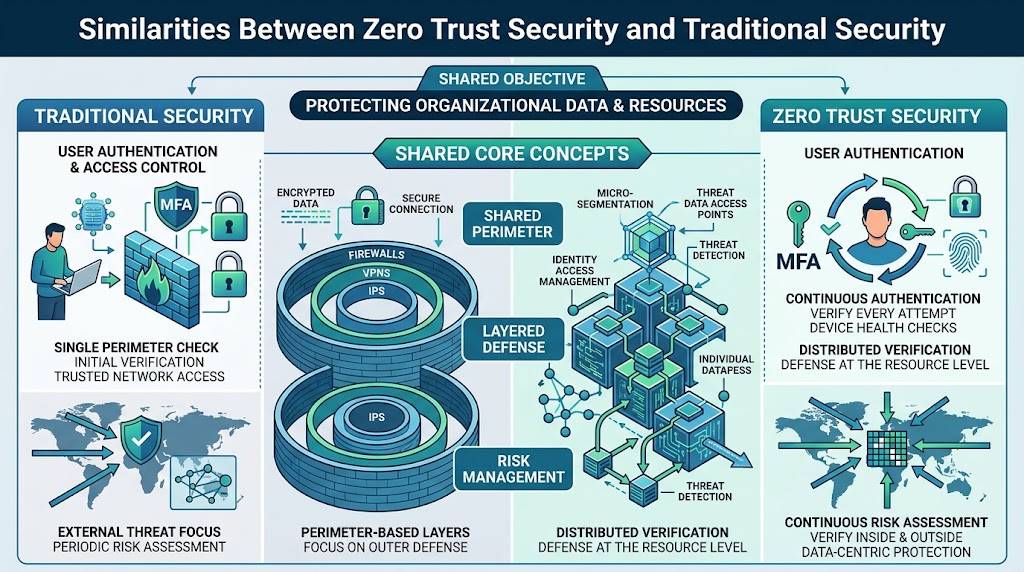
Although the two models use different security approaches, they share the same fundamental objective: protecting an organization’s valuable data and resources.
User Authentication and Access Control
Traditional security uses external defenses to keep threats outside the network, while zero trust continuously verifies users and devices.
Both approaches depend on strong authentication methods, including multi-factor authentication (MFA), to ensure that only authorized users can access sensitive information.
Layered Defense
Both models use defense in depth.
Traditional security commonly relies on layers such as firewalls, VPNs, and intrusion prevention systems (IPS). Zero trust extends the verification approach to individual access points instead of focusing only on the network perimeter.
Risk Management
Both models address security risks, but they approach them differently.
Traditional security focuses primarily on blocking external threats. Zero trust assumes that threats can originate anywhere and continuously verifies access attempts both inside and outside the organization.
4. Benefits of the Zero Trust Security Model
Traditional perimeter security becomes harder to rely on as organizations adopt cloud computing, remote work, mobile devices, and more sophisticated cyber threats.
Zero trust removes default trust and continuously validates users, devices, and applications regardless of whether they are inside or outside the network.
1. Continuous Verification for Enhanced Security
Traditional security may grant access after a user crosses the network boundary.
Zero trust requires continuous verification for access attempts. This means access is checked regardless of the user’s location or device, helping prevent unauthorized users from exploiting vulnerabilities.
2. Reduced Attack Surface
Zero trust limits access to the resources required for a user’s role.
By applying least-privilege access, it reduces the attack surface and limits the potential impact if an attacker breaches the environment.
3. Adaptability to Modern Work Environments
Remote work and cloud-based services make traditional perimeter security more difficult to apply across decentralized environments.
Zero trust is designed to support cloud applications, on-premises systems, and mobile endpoints, providing security that fits modern work environments.
4. Stronger Identity and Access Management
Zero trust continuously validates identities through methods such as multi-factor authentication, user behavior analysis, and real-time risk assessments.
This helps ensure that only authorized entities can access critical resources.
5. Proactive Defense Against Evolving Threats
Zero trust continuously adapts to changing threats and strengthens protection against advanced attacks, insider threats, and breaches that may occur inside the network.
Traditional security often relies more heavily on responding after a breach, while zero trust continuously verifies access and reduces implicit trust.
5. Zero Trust Security vs Traditional Security Model: Comparison Table
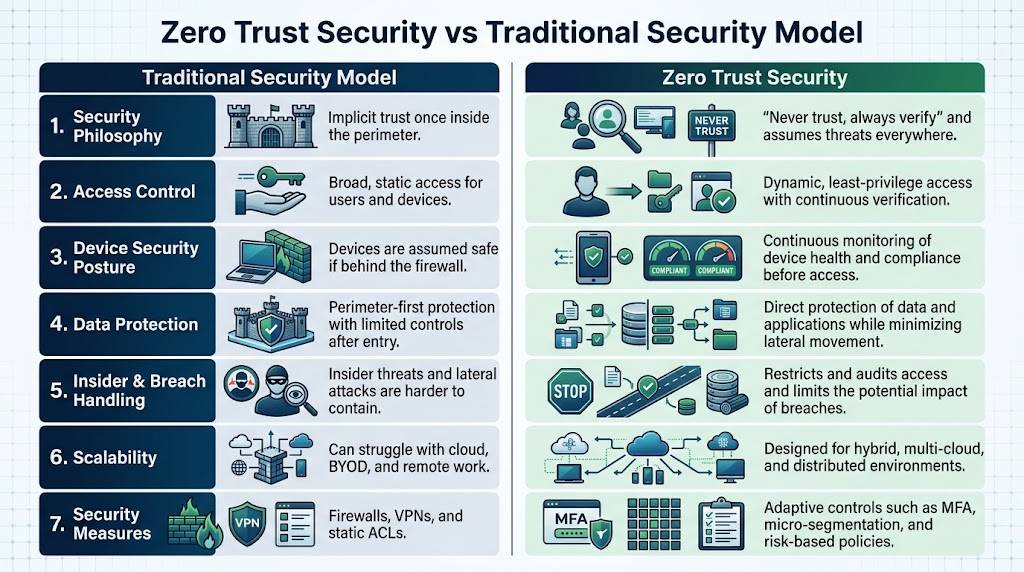
The following table compares the two models across security philosophy, access control, device security posture, data protection, breach handling, scalability, and security measures.
| Aspect | Traditional Security Model | Zero Trust Security |
|---|---|---|
| Security Philosophy | Implicit trust once inside the perimeter. | “Never trust, always verify”—assumes threats everywhere. |
| Access Control | Broad, static access for users and devices. | Dynamic, least-privilege access with continuous verification. |
| Device Security Posture | Devices assumed safe if behind the firewall. | Continuous monitoring of device health and compliance before access. |
| Data Protection | Perimeter-first; limited controls after entry. | Direct protection of data and applications, minimizing lateral movement. |
| Insider & Breach Handling | Insider threats and lateral attacks are harder to contain. | Restricts and audits access and limits the potential impact of breaches. |
| Scalability | Can struggle with cloud, BYOD, and remote work. | Designed for hybrid, multi-cloud, and distributed environments. |
| Security Measures | Relies on firewalls, VPNs, and static ACLs. | Uses adaptive controls such as MFA, micro-segmentation, and risk-based policies. |
6. Use Cases of the Zero Trust Security Model
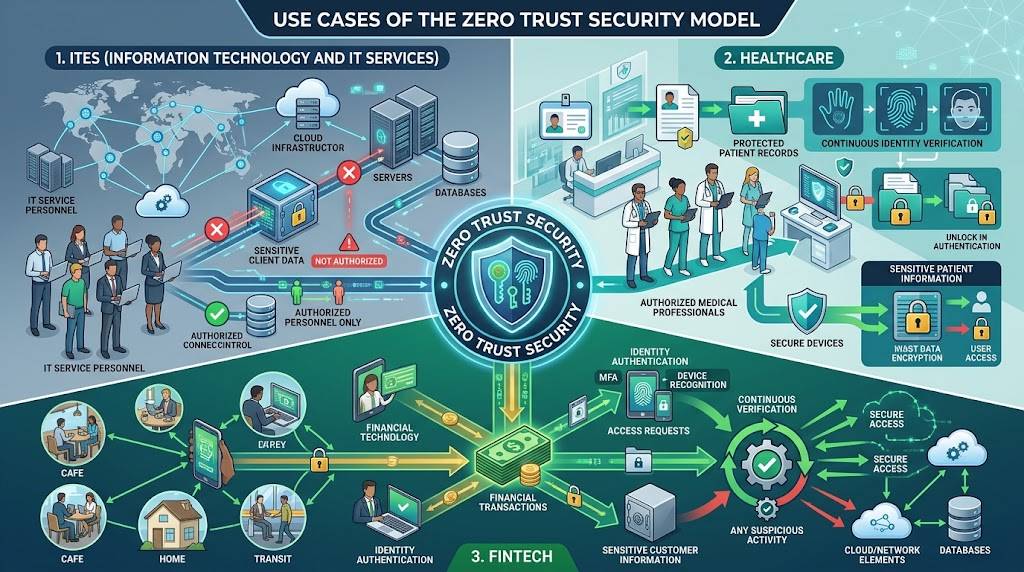
1. ITES (Information Technology and IT Services)
Zero trust is useful for ITES organizations that support distributed networks and handle sensitive customer data.
By using zero trust access, ITES providers can ensure that only authorized personnel access client data. Even within the organization, access can be limited to specific servers or databases.
2. Healthcare
Healthcare organizations handle highly sensitive patient information, so access must be tightly controlled.
Zero trust can ensure that only authorized users access specific data when necessary. For example, healthcare providers can restrict patient records to authorized medical professionals while using real-time access monitoring and continuous identity verification.
3. FinTech
FinTech organizations handle financial transactions and sensitive customer information while employees may access corporate resources from different locations and devices.
The source article cites the 2021 Financial Services Data Risk Report, which reported that 59% of financial services companies had more than 500 passwords that never expired, while nearly 40% had more than 10,000 ghost users.
Zero trust addresses these types of access risks by continuously verifying access requests and enforcing identity authentication and access control policies, including when employees connect from different locations.
7. Transform Security From Perimeter to Precision With Scalefusion OneIdP
Zero trust provides a modern approach for organizations seeking stronger security across changing environments.
According to the source article, Scalefusion OneIdP supports a transition toward a zero-trust model by continuously verifying access requests and ensuring that authorized users can access sensitive data regardless of their location or device.
The source also describes OneIdP as using identity and access management capabilities and granular access controls to move beyond traditional perimeter-based security.
8. Closing Thoughts
Traditional perimeter security was designed around the idea that a protected internal network could be trusted. Modern environments are more distributed, with remote work, cloud services, and mobile devices changing how users access resources.
Zero trust takes a different approach by assuming that users, devices, and applications should not be trusted automatically. Instead, access is continuously verified and controlled according to identity, device status, and required permissions.
NIST’s zero trust guidance similarly emphasizes protecting resources rather than relying primarily on network location or a traditional perimeter.
For organizations evaluating the move from traditional security to zero trust, the key difference is straightforward: traditional security emphasizes protecting the perimeter, while zero trust emphasizes continuously verifying access to resources.
FAQ
Do I need to completely replace my existing security infrastructure to implement zero trust?
No. The source explains that organizations do not necessarily need a complete replacement. Zero-trust principles can be layered onto existing systems, allowing organizations to strengthen protection over time while reducing disruption.
What are the biggest challenges when transitioning from traditional to zero trust security?
The main challenges identified in the source include:
- Moving away from implicit trust inside a traditional perimeter.
- Integrating new security controls.
- Verifying device security posture.
- Managing hybrid systems.
- Enforcing least-privilege access.
Is zero trust realistic for companies with hybrid or legacy systems?
Yes. The source explains that zero trust can be applied to hybrid and legacy environments by securing critical data and systems, verifying device security, and applying adaptive access policies.
NIST also describes zero trust as applicable to environments involving remote users, BYOD, and cloud-based assets outside traditional enterprise boundaries.
How does zero trust improve protection against insider threats?
Traditional security may trust users once they are inside the network. Zero trust assumes that threats can exist anywhere and applies strict authentication, device security checks, and controlled access to sensitive resources.
What traditional security failures can zero trust help address?
The source identifies examples such as phishing-related breaches, ransomware moving across networks, and insider data theft.
Zero trust addresses these risks by continuously verifying access and restricting movement within the network.
How does zero trust architecture improve security?
Zero trust improves security by removing implicit trust, continuously verifying users and devices, and enforcing least-privilege access.
It protects data and systems directly, reduces the attack surface, and strengthens security across identities, devices, and applications.